When selecting heavy-duty climbing carabiners, the focus is on strength, reliability, and ease of use. The following five models are among the most robust options on the market, featuring UIAA certification, auto-locking mechanisms, and solid materials designed for rope systems, rescue work, and rugged outdoor activity. Read on to compare key features and practical considerations for each option.
| Product | Brand | Strength (Major Axis) | Lock Type | Ideal Use |
|---|---|---|---|---|
| FresKaro 25kN Double Locking Carabiner | FresKaro | 25 kN | Double Locking | Rappelling, Rock Climbing |
| BEIFENG Auto Locking Carabiner 25KN | BEIFENG | 25 kN | Auto-Locking | Rappelling, Climbing |
| BEIFENG 25KN Auto Locking Carabiner (4-Pack) | BEIFENG | 25 kN | Auto-Locking | Climbing, Camping |
| DEKABR Heavy Duty Alloy Steel Carabiner | DEKABR | 45 kN | Auto-Locking | Rescue, Mountaineering |
| JRSGS Locking Carabiner | JRSGS | 25 kN | Locking | Climbing, Rescue |
The table above highlights major-axis strength, locking style, and typical use cases to help you choose the right carabiner for your rope systems and safety requirements. All models listed meet common industry standards and offer features to minimize snagging and accidental opening during movement and loading.
FresKaro 25kN Double Locking Carabiner

The FresKaro model features a quick-lock system designed for one-handed operation: twist the barrel, apply pressure, and the carabiner opens with automatic re-locking when released. With a UIAA-certified major axis strength of 25 kN and a 7 kN cross-load rating, this hot-forged D-shaped carabiner is built for various outdoor activities such as rock climbing, rappelling, and rescue tasks. The design emphasizes a deep basket and a snag-resistant nose guard to reduce fumbling and snagging during handling.
BEIFENG Auto Locking Carabiner 25KN

BEIFENG’s auto-locking carabiner uses aviation-grade aluminum to deliver a light yet strong piece with a 25 kN longitudinal strength and 7 kN lateral load. Its compact D-shaped profile, surface finishing, and one-handed operation enable quick access in challenging conditions. The locking mechanism engages automatically when pressure is released, simplifying safety during ascent, descent, or rope work while maintaining a secure hold on gear and anchors.
BEIFENG 25KN Auto Locking Carabiner (4-Pack)

This four-pack provides consistency across multiple points on a system, ensuring reliable locking and ease of inspection across connected gear. The same aviation-grade aluminum and 25 kN longitudinal strength are employed, with the same one-handed operation and automatic locking feature. Its compact size makes it practical for sportive climbing kits, rescue lines, and anchor setups where multiple carabiners are required.
DEKABR Heavy Duty Alloy Steel Carabiner
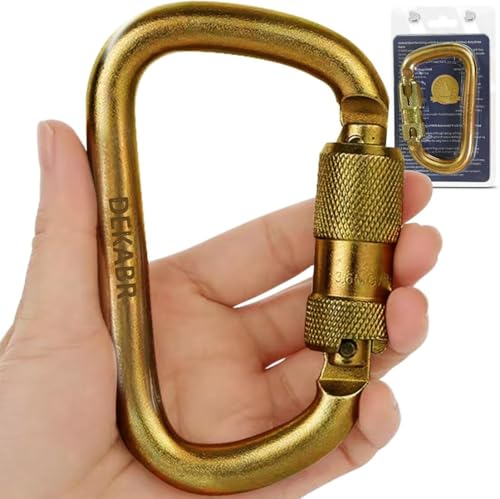
DEKABR’s heavy-duty alloy steel model delivers a standout 45 kN major-axis strength, with 16 kN lateral load capacity. Constructed through heat-treated forging processes, it pairs a robust D-shaped profile with a double-lock mechanism for added security. The large body, gold finish, and single-handed operation support demanding activities such as tree climbing, rescue operations, and mountaineering, where high reliability is essential for anchor connections and rope systems.
JRSGS Locking Carabiner

JRSGS offers a UIAA-certified locking carabiner with a major-axis strength of 25 kN and a 7 kN cross-load rating. Its knurl-knob design enhances grip for quick locking and unlocking, reducing the time spent adjusting gear while climbing or performing rope work. The ergonomic D-shaped form, compact dimensions, and one-handed operation make it suitable for ascent and rescue operations, as well as everyday gear setups where dependable locking is a priority.
Buying Guide: Key Purchase Considerations
Strength ratings and certification matter most for safety-critical uses. Look for UIAA or CE certifications that verify the major-axis strength and cross-loading resistance. Consider lock type: auto-locking mechanisms reduce the chance of accidental opening in active settings, while screw-lock options provide a tactile confirmation before re-engagement. Material and weight are important for extended climbs; aviation-grade aluminum balances strength with lightness, whereas steel variants offer superior durability for stationary or rescue applications.
- Strength and load direction: Major-axis strength should meet or exceed the anticipated loads; cross-load ratings help in side-loading scenarios.
- Locking reliability: Auto-locking systems minimize user error; ensure the mechanism engages smoothly and relocks automatically after use.
- Size and shape: D-shaped carabiners optimize load distribution on the spine; larger openings ease rope and pulley integration but can add weight.
- Weight vs. durability: Heavier steel carabiners may offer higher durability in rugged environments, but lighter aluminum variants improve carry comfort on long routes.
- Purpose-fit: Some carabiners are optimized for rescue, others for hiking gear, hammocks, or camera attachments. Choose those designed for climbing, rappelling, or rescue as appropriate.
- Durability and coatings: Corrosion resistance and protective coatings extend service life in outdoor exposure and humid conditions.
For practical setups, many climbers prefer a balanced mix: a couple of auto-locking aluminum carabiners for main anchors, a heavier-duty backup option for high-load points, and a few lighter locking carabiners for peripheral gear. Always inspect for wear, burrs, or deformation before each use, and retire any piece showing signs of structural compromise.
Add a Comment