Discover blue foam balance pads designed to boost stability, balance, and core strength across workouts, rehabilitation, and daily activities. This guide highlights five top blue pads, their features, and how to choose the right one for your needs.
| Product | Brand | Key Benefit |
|---|---|---|
| ProsourceFit Exercise Balance Pad | ProsourceFit | Unstable surface to improve balance and core strength |
| ANVICTOX Balance Pad XL | ANVICTOX | Extra-large surface for taller users and rehab therapy |
| StrongTek Professional Foam Pad | StrongTek | High-density TPE, non-slip, spacious size |
| Yes4All Balance Pad XL | Yes4All | Multiple sizes, soft TPE foam for comfort |
| AIREX Balance Pad Basic | AIREX | Lightweight, non-slip, trusted rehab pad |
Use the table above as a quick reference to compare size, surface, and stability features. Each pad offers a different blend of surface area, material density, and grip to suit diverse fitness levels and rehab goals.
ProsourceFit Non-Slip Balance Pad
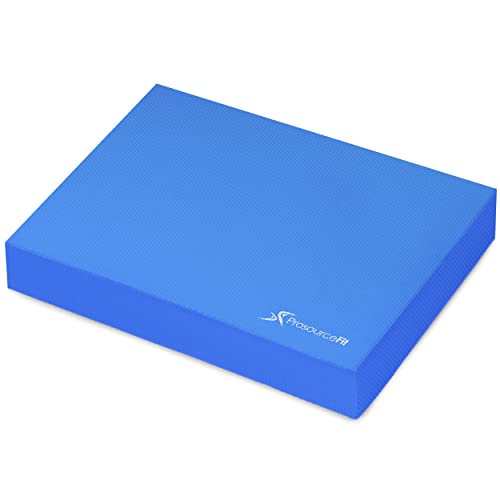
The ProsourceFit balance pad uses non-toxic TPE material to create a slightly unstable surface that challenges balance and core stability during workouts. It is slip-resistant, sweat-proof, and easy to clean, making it a practical option for yoga, rehabilitation, and general training. Its compact dimensions accommodate a wide range of exercises from standing balance to kneeling movements, suitable for users at various fitness levels.
ANVICTOX XL Balance Pad

The ANVICTOX XL balance pad measures 19.8 by 15.7 inches and 2.4 inches thick, offering a large surface for taller individuals and more complex rehab movements. Made from TPE, it emphasizes elasticity, resilience, and easy cleaning. The pad is designed to support balance, stability, and mobility training across a spectrum of users, from physical therapy to athletic conditioning. Its larger size can improve confidence for standing and dynamic drills.
StrongTek Professional Foam Pad

StrongTek offers a high-density TPE foam balance pad with a generous 15.8 by 13-inch footprint and 2-inch thickness. The pad is non-slip and water-resistant, designed to deliver secure footing during balance poses, rehabilitation exercises, yoga, and Pilates. Its ample surface area supports a wide range of movements while protecting joints and supporting proper alignment during workouts.
Yes4All Balance Pad XL

Yes4All offers upgraded sizes in a nonslip TPE foam balance pad family, with the XL option providing an expansive surface for stability-focused workouts and rehab. The pad balances softness with sufficient support to enhance balance, strength, and daily functional activities. It is versatile for yoga, standing work, and seated stabilization tasks, accommodating users across different heights and body types.
AIREX Balance Pad Basic

The AIREX Balance Pad Basic is a trusted, lightweight option designed for balance and mobility work. Its non-slip surface and closed-cell foam construction offer durability during therapy and exercise routines. The pad functions well as a planking, kneeling, or standing mat, supporting stability training, plantar flexibility, and joint protection in home rehab programs.
Buying Guide: Key Considerations for Choosing a Blue Balance Pad
- Surface area and thickness: Larger pads offer more stability for taller users or dynamic movements, while thinner pads promote a greater challenge for balance work. Choose based on your height, space, and exercise goals.
- Material and density: High-density TPE foam provides durability, better grip, and joint protection. Look for non-toxic, sweat-resistant materials for hygiene and longevity.
- Grip and non-slip design: A textured or reinforced non-slip surface improves safety, especially during barefoot training or sweaty sessions.
- Portability: If you plan to travel or train in multiple spaces, consider pad weight and portability. Some XL models may be bulkier but offer more stability for rehab work.
- Intended use: Rehab-focused pads emphasize joint protection and controlled movements, while performance pads focus on challenging balance and core strength. Align with your exercise modality (yoga, physical therapy, Pilates, general fitness).
- Maintenance and cleaning: Look for materials that are easy to wipe down and resist moisture buildup to maintain hygiene between sessions.
- Durability and warranty: Heavier use may require a pad with strong seams and a non-slip surface designed to tolerate frequent flexing and compression over time.
- Size guidance for choosing: For smaller spaces or beginners, a compact pad may suffice; for rehab or taller users, an XL model can provide better coverage and stability.
Choosing by fitness level
Beginners may prefer a slightly larger, softer pad to build balance confidence, while intermediate to advanced users can benefit from a firmer pad with a larger footprint to challenge stability and core control.
Practical usage tips
- Start with simple standing balance exercises, progressing to dynamic movements like single-leg reaches and squats on the pad.
- Pair with a mirror or trainer feedback to ensure proper knee alignment and hip stability.
- In rehab, follow professional guidance for progression, focusing on controlled movements and gradual intensity increases.
Add a Comment