Finding the most accurate .177 caliber pellets depends on your airgun, shooting style, and intended use—plinking, target practice, or varmint hunting. The following selections pool together well-rounded options from trusted brands to help you compare performance, weight, and geometry. Each product is evaluated for consistency, penetration, and impact behavior to support precise, repeatable results in American backyards and ranges.
| Product | Brand | Caliber | Grain | Count | Notes |
|---|---|---|---|---|---|
| H&N Sport Hornet Pointed | H&N Sport | .177 | 9.6 | 225 | Pointed, gray finish; single pack |
| Crosman DS177 Destroyer | Crosman | .177 | NA | 250 | Hybrid pointed/hollow-point design |
| H&N Terminator Hollowpoint | H&N Sport | .177 | 7.25 | 400 | Hollowpoint for controlled expansion |
| Stoeger X-Power Maximum | Stoeger | .177 | NA | 500 | Copper-coated; dome shape |
| H&N Baracuda Hunter Extreme | H&N Sport | .177 | 9.57 | 400 | Hollowpoint with enhanced shock |
Below you’ll find concise profiles for five highly regarded .177 pellets. Each section includes an image, quick references to the key features, and a breakdown of the target applications and performance considerations. This structure helps you compare options side by side and choose pellets that align with your firearm, shooting conditions, and personal preference.
H&N Sport Hornet Pointed Pellets

Caliber: 0.177 inches. Quantity: 225 pellets. Style: Single Pack. The Hornet Pointed pellets are designed for a combination of accuracy and penetration, thanks to a carefully shaped point that assists consistent flight and impact behavior. This option suits shooters seeking reliable, mid-weight performance for general target practice and recreational shooting.
Crosman DS177 Destroyer Pellets

.177-caliber pellets with a destroyer-style head that blends pointed and hollow-point characteristics. This design aims to provide versatile performance for recreational use, balancing penetration and expansion. The 250-count package offers steady supply for frequent practice sessions and sighting-in routines.
H&N Terminator Hollowpoint Pellets

Caliber: 0.177. Quantity: 400 pellets. These hollowpoint pellets are designed to deliver reliable expansion on impact while maintaining consistent trajectory. The Terminator line emphasizes accuracy at range and predictable behavior in sport and practice shooting, making them a solid choice for precision shooters.
Stoeger X-Power Maximum Penetration Pellets

Caliber: 0.177. Copper-coated lead dome-point pellets designed for maximum penetration. They are suitable for field and target practice, especially when longer-range accuracy and deeper penetration are desired. The package includes 500 pellets, offering a economical supply for ongoing training. The product carries a five-year limited warranty against manufacturing defects.
H&N Baracuda Hunter Extreme Hollowpoint Pellets
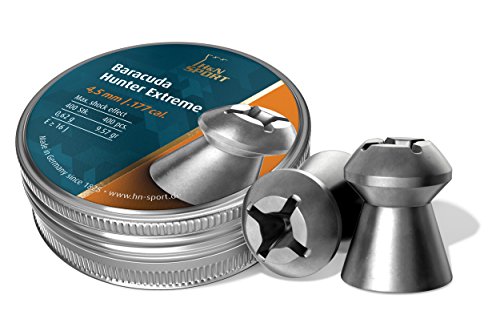
Caliber: 0.177 inches. Quantity: 400 pellets. Hollowpoint with a high shock effect. The Baracuda Hunter Extreme line is designed for reliable expansion and impact energy, making it a strong choice for targets where consistent stopping power and accuracy are important. The 9.57-grain weight contributes to stable flight in many air rifles.
Buying Guide: Key Considerations For Choosing .177 Pellets
- Pellet weight and style: Heavier pellets (around 9–9.6 grains) generally offer better stability and penetration at distance, while lighter pellets provide flatter trajectories for shorter-range targets. Hollowpoints are designed for expansion; pointed pellets can improve penetration, depending on the target and rifle.
- Pellet geometry: Pointed, hollowpoint, and domed shapes each interact differently with air resistance and rifling. For hunting or varmint control, hollowpoints and pointed designs are often favored for reliable expansion or penetration; for plinking and target practice, domed or hybrid shapes may yield tighter groups.
- Consistency and batch quality: Look for a consistent count per tin and uniform pellet dimensions. Inconsistent pellets can degrade accuracy and velocity consistency across shots.
- Rifle compatibility: Some pellets group better in certain rifles due to crown, barrel, and bore dimensions. It’s common to test multiple brands to determine the best match for your specific airgun.
- Target use vs. field use: For target shooting, precision and consistency are paramount. For field or pest control, consider penetration and expansion characteristics as well as energy delivery at practical distances.
- Pairing with sights and torque: When testing pellets, ensure your sight alignment and trigger control are optimized, as pellet quality alone cannot compensate for user technique or misalignment.
- Safety and regulation: Always follow local laws and safety guidelines for airgun use, storage, and transport. Proper backstops and prime-of-field safety should be observed during practice sessions.
Choosing pellets involves balancing weight, expansion behavior, and flight stability for your specific airgun and shooting goals. The five options presented provide a spectrum of designs—from pointed to hollowpoint to copper-coated domes—allowing you to test and compare performance across practical scenarios while maintaining safety and consistency in your practice routine.
Add a Comment